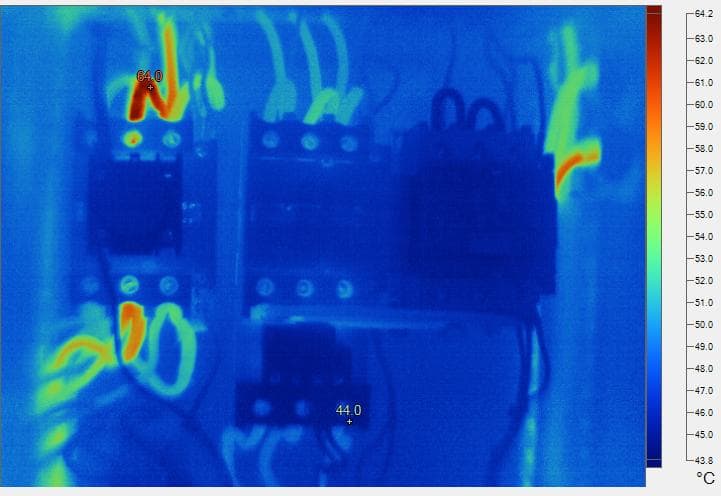
Infrared Thermography
Advanced thermal diagnostics used to identify hidden faults, overheating components, and asset reliability risks before failure occurs.
Key Features
- Non-contact, non-invasive inspections while equipment remains operational
- LaserSharp™ Precision Focus for pinpoint temperature accuracy
- High-resolution thermal analysis capable of detecting gradients as small as 0.05°C
- IR-Fusion™ technology combining visible and thermal imaging for contextual analysis
- Detailed thermal imaging for early-stage component fatigue detection
Benefits
- Supports predictive maintenance programs
- Identifies root causes such as load imbalance, insulation failure, and loose connections
- Prevents unplanned downtime and costly equipment failures
- Provides detailed reporting with severity ranking and repair priorities
- Improves reliability and operational safety
- Helps transition from reactive to proactive maintenance strategies
Applications
- Switchgear & Control Gear
- Transformers & Bushings
- Motor Control Centers (MCCs)
- Distribution Boards & Busbars
- Rotating Equipment (Bearings & Gearboxes)
- Drive Systems & Belt Alignments
- Mobile Plant Equipment
- Steam Systems & Steam Traps
- Furnaces, Boilers & Kilns
- Tank & Vessel Thermal Level Monitoring
Technical Standards & Compliance
- •Minimum 40% operational load requirement in accordance with NFPA 70B standards
- •ISO 18436 certified inspection personnel
- •Alignment with NFPA 70B and ISO electrical and mechanical maintenance standards
- •High-integrity diagnostic process ensuring accurate thermal signatures
Strategic Benefits for Your Facility
- •Predictive maintenance integration
- •Root cause identification before catastrophic failure
- •Reduced maintenance costs and downtime
- •Enhanced operational safety
- •Data-backed maintenance prioritization
Preventive Maintenance
Infrared thermography allows early fault detection before issues become critical failures, reducing repair costs and increasing asset lifespan.
- •Early detection of thermal anomalies
- •Reduced maintenance expenditure
- •Extended equipment operational life
- •Improved maintenance scheduling
Safety & Compliance
Thermographic inspections support regulatory compliance and reduce operational risk by identifying hidden hazards before failure occurs.
- •NFPA 70B aligned inspections
- •Reduced fire and electrical failure risk
- •Compliance documentation for audits and insurance
- •Improved personnel and facility safety
Frequently Asked Questions
What is infrared thermography inspection?
Infrared thermography uses thermal imaging cameras to detect temperature variations in electrical panels, motors, transformers, and mechanical equipment. It identifies overheating components, loose connections, and insulation failures — without any shutdown or contact with equipment.
How often should I schedule an infrared thermography inspection?
For industrial facilities, we recommend a minimum of one inspection per year. High-load or critical facilities such as power plants benefit from quarterly inspections to catch developing faults early.
Does infrared thermography require equipment shutdown?
No. Thermography is a non-contact, non-destructive test performed with equipment running under normal load, making it one of the safest and least disruptive predictive maintenance techniques available.
Complementary Engineering Services
Integrated diagnostic technologies that strengthen findings, validate root causes, and provide a complete reliability engineering solution.
Engineering Audit & Installation Compliance
Performed according to TBS, BS 7671, and IEC 60364 standards to uncover latent design and installation defects.
- Material Integrity (SWA vs. AWA)
- Gland & Plate Management
- System Bonding & Grounding
- Cable Configuration Validation
Electrical Condition Monitoring
Advanced electrical diagnostics identifying hidden system reliability risks.
- Airborne & Structure-Borne Ultrasound
- Power Quality Analysis (PQA)
- Transformer Asset Management
- Insulation Resistance Testing
Mechanical & Process Reliability
Integrated monitoring for mechanical health and process performance optimization.
- Vibration Analysis
- Acoustic Imaging
- Steam Trap & Valve Audits
- Refractory & Tank Profiling